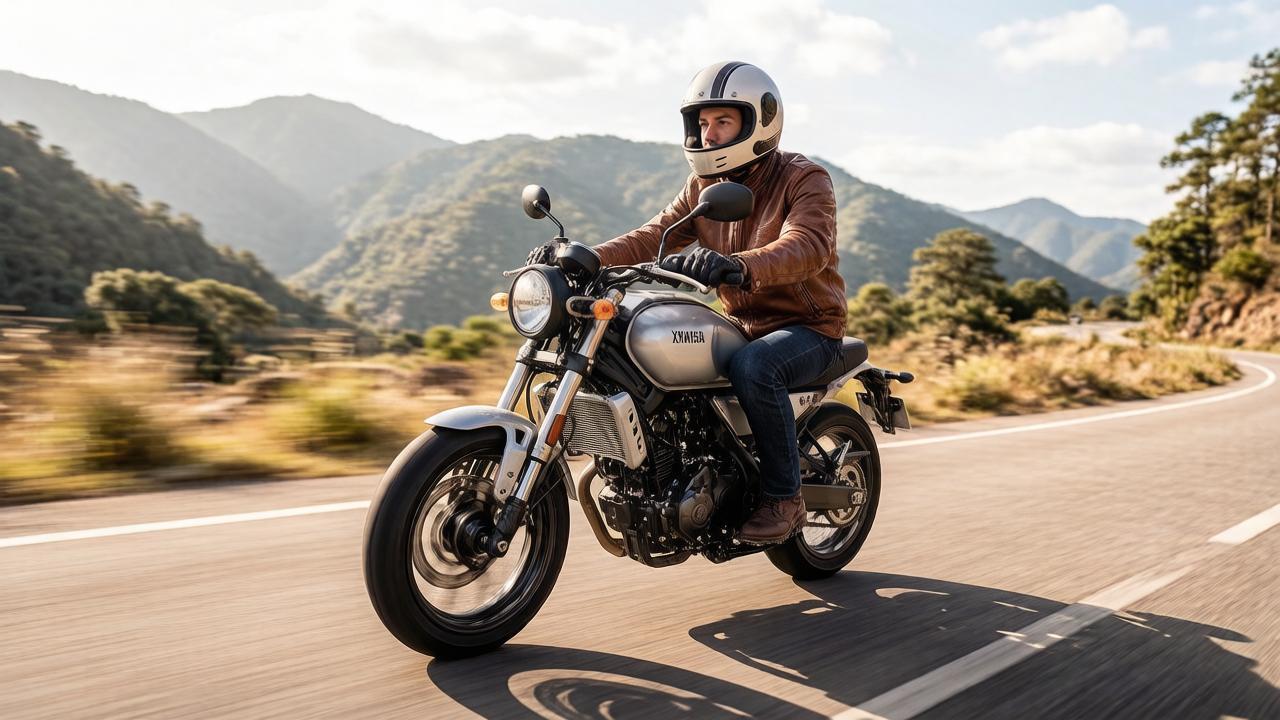
Executing long-range exploratory tracking missions into the rugged border territories of Northern Thailand requires a mechanical asset that balances old-school structural aesthetics with cutting-edge powertrain telemetry. As road elevations alter violently and track conditions degrade into gravel singletracks, a rider must maintain a symbiotic connection with the engine and gearbox. While modern automatic transport platforms satisfy basic commuting needs, true mechanical purists demand manual clutch articulation, selectable gear ratios, and a rigid backbone frame that converts raw power into unyielding forward momentum along complex asphalt curves.
For independent international exploration units establishing a mobile operational perimeter, choosing a proper mobility asset defines the entire scope of the campaign. The default logistical reflex for most urban arrivals is to secure a generic, low-displacement automatic unit from a standard high-volume scooter rental agency to navigate immediate downtown districts. However, once the mission profile expands to include scaling steep alpine ascents and navigating unlit valley passes, light automatic transmissions quickly experience extreme belt slip and thermal throttling. Stepping up to a manual, sport-tuned platform like the Yamaha XSR155 introduces total mechanical authority, shifting gear management back to the rider’s left boot and providing the high-RPM stability required to dominate remote mountain loops.
The dawn operations commence at the base of the northern foothill perimeter under cool atmospheric conditions. Firing up the XSR155 reveals a crisp, mechanical exhaust note from the liquid-cooled, 4-stroke, SOHC, 4-valve engine block. Boasting a precise 155cc displacement, this fuel-injected powerplant shares its racing DNA directly with the legendary YZF-R15 supersport platform. The engine features Variable Valve Actuation (VVA) technology, which utilizes an electronic solenoid to shift the intake cam profile at exactly 7,400 RPM. This engineering choice guarantees that while low-end grunt remains perfectly manageable inside urban staging areas, the top-end acceleration remains aggressive and unyielding once the road opens up into high-velocity highway straightaways.
Navigating the initial highway sectors demonstrates the immediate advantage of the Assist & Slipper clutch assembly. This specialized mechanical clutch hub uses an assist cam to pull the pressure plate together during acceleration, reducing clutch lever pulling effort by over twenty percent. Simultaneously, during high-velocity approaches to low-speed intersections, the slipper cam mitigates back-torque from the rear wheel during sudden downshifts. This prevents the rear tire from hopping or breaking traction on dew-slicked asphalt, ensuring the chassis tracks straight and true as you scrub off massive entry speed.
As the sun reaches its zenith, the track transitions into severe mountain topology, scaling vertical inclines exceeding a fifteen-percent gradient. This is where the structural layout of the DeltaBox frame proves its engineering worth. Moving entirely away from flimsy underbone scooter frames, the DeltaBox architecture features a rigid box-section perimeter layout wrapping tightly from the steering head down to the swingarm pivot. This configuration provides immense torsional rigidity, completely eliminating lateral frame flex when the machine is thrown hard into high-g compression dips at the base of steep valleys.
Suspension damping is managed by heavy-duty inverted front forks featuring substantial 37mm inner tubes paired with a link-type Monocross rear shock absorber. The upside-down front fork layout sheds massive unsprung weight from the front wheel assembly while increasing structural resistance against braking forces. When executing hard trail-braking maneuvers into tight mountain switchbacks, the frontend preserves its structural alignment, delivering crystal-clear feedback through the aluminum handlebars and allowing the rider to locate the optimal traction threshold with precision.
Twilight operations introduce shifting environmental variables as mountain mist rapidly condenses across the asphalt lanes. The rolling stock inventory on the XSR155 consists of lightweight multi-spoke alloy rims mounting premium dual-purpose tubeless tires, with a substantial 110/70-17 profile upfront and a massive 140/70-17 footprint at the rear. The block-pattern tread design provides an expanded mechanical contact patch that excels at cutting through thin layers of wet surface dust and loose trail gravel run-off, maintaining a predictable drift slide angle if the limits of traction are exceeded.
Stopping power is governed by dual hydraulic disc circuits, featuring a large front disc clamped by a dual-piston caliper and a responsive rear disc setup. The progressive lever feel allows for micro-modulations of braking pressure mid-corner, preventing suspension upset when adjusting lines around unexpected obstacles. The electronic cockpit relies on a vintage-style circular LCD console that outputs high-contrast real-time telemetry including digital gear indicator, current VVA status, total fuel range calculation, and average velocity tracking metrics.
Ultimately, the Yamaha XSR155 bridges the gap between heritage design philosophy and high-performance modern dynamics. It successfully discards the passive utility constraints of standard automatic machinery, replacing them with a highly responsive, manual powertrain matrix that thrives under pressure. By placing absolute mechanical control directly into the hands of the operator, this neo-retro platform ensures your long-range tracking campaigns through the challenging alpine networks remain fast, rewarding, and entirely under your command.