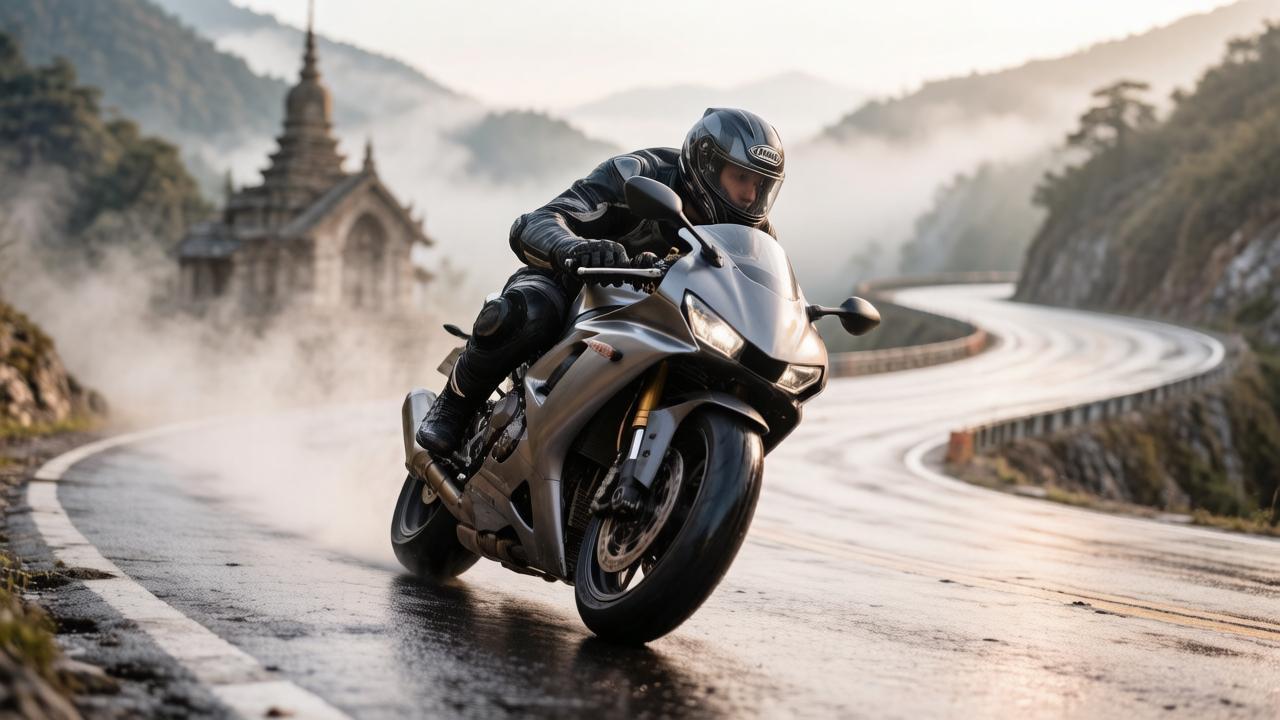
The vertical ascent up the Doi Suthep mountain highway stands as one of the most accessible yet highly deceptive tracking segments in Northern Thailand. Rising sharply from the northwestern urban perimeter, this asphalt corridor serves as an immediate test of a machine’s cooling capacity and a rider’s braking discipline. While the road surface is generally wide and well-maintained by municipal authorities, the continuous sequence of high-velocity sweepers, sudden compression zones, and blind switchbacks hidden beneath dense jungle canopies requires a highly calculated approach and absolute mechanical responsiveness.
Executing this mountain climb with precision requires selecting a machine configured for continuous vertical loading. Many casual travelers arriving in the region fail to account for the extreme elevation changes, renting worn-out, high-mileage fleet units that quickly overheat or experience severe brake fade. If your target objective is to reach the high summit or venture deeper into the remote Doi Pui tribal sectors, taking the time to find a premium chiang mai rent scooter facility that supplies modern, liquid-cooled fuel-injected units is paramount. Operating a platform with fresh synthetic fluids, highly responsive brake pads, and sports-grade tire compounds transforms a stressful, underpowered climb into a controlled, high-velocity alpine ascent.
Elevation Coefficient
The track climbs from an urban baseline of 312 meters to a peak altitude of over 1,050 meters above sea level within a tight 12-kilometer trajectory, generating immense thermal stress on automatic transmissions.
Microclimate Factors
As altitude increases, ambient air temperatures drop up to 6 degrees Celsius. Condensation frequently deposits a micro-film of moisture across the asphalt in shaded canopy zones.
Anatomy of the Ascent: Key Turning Sectors
The Doi Suthep circuit can be split into three distinct mechanical phases. The first phase initiates immediately past the regional zoo checkpoints. This sector features wide, sweeping curves with excellent visibility lines where riders can establish a high-RPM rhythm. The primary hazard here is the variable speed differentials of heavy tourist transport vans, requiring decisive overtaking maneuvers executed precisely within designated passing lanes before the road transitions into single-track boundaries.
The second phase begins as you approach the mid-way viewing platform. Here, the road geometry tightens significantly, introducing decreasing-radius curves that actively pull the machine toward the outer guardrails if your entry speed is uncalibrated. This sector requires a deep understanding of trail-braking mechanics, dragging the rear brake caliper slightly to stabilize the chassis chassis right up to the point where the apex becomes fully visible. Smooth throttle roll-on is mandatory to maintain rear wheel tracking out of the corner exit.
The final phase leading to the high temple grounds is characterized by extreme gradients and tight, consecutive switchbacks. The engine must work under peak load, making liquid-cooling systems and optimized CVT roller weights critical assets. If your automatic transmission is configured with worn or overly heavy rollers, the engine will drop below its optimal power band, stalling your vertical momentum and compromising your stability through low-speed cornering balancing maneuvers.
Surface Friction Metrics and Environmental Traps
Unlike controlled racing environments, public mountain tracking requires constant evaluation of changing surface textures. The dense tropical jungle flanking the road continuously drops organic debris onto the asphalt surface. Wet leaves, crushed gravel from run-off channels, and oil deposits from commercial engines accumulate right along the optimal racing lines, particularly within the deep inside gutters of sharp turns.
Riders must avoid dragging their exhaust hardware or floorboards against the concrete curbing. Sudden physical contact with fixed infrastructure unweights the tires and causes immediate low-side incidents. Maintaining a tight, disciplined body position—shifting your upper torso forward and down toward the inside mirror—allows the machine to corner effectively while minimizing the required physical lean angle of the actual metal chassis frame.
- [!]
Braking Protocol: Execute all heavy deceleration before committing to the turn. Avoid mid-corner front brake stabs on damp asphalt. - [!]
Line Selection: Avoid the absolute edge of the road where loose sand and gravel accumulate via rainwater drainage. - [!]
Thermal Monitoring: If your machine displays a temperature warning indicator, immediately pull out of the throttle line and idle on a flat surface.
Descent Management and Caliper Integrity
Conquering the summit is only half the mission; navigating the continuous downhill descent requires even greater mechanical sympathy and tactical discipline. Gravity accelerates the machine rapidly, placing the entire burden of speed management directly onto your front and rear hydraulic braking loops. If a rider continuously drags the brake levers down the mountain, the localized thermal buildup will rapidly boil the DOT 4 brake fluid, inducing immediate system failure.
To avoid this dangerous scenario, apply a rhythmic braking pattern—braking firmly before a corner, then completely releasing the levers along the short straightaways to allow fresh airflow to pass over the hot discs and dissipate the thermal load. By matching your mechanical inputs to the physical demands of the topography, you safeguard your hardware assets and ensure your mountain transit remains sharp, responsive, and completely under your tactical command.